Pragmatic Haskell: Building a Microservice Template
/ 13 min read
Table of Contents
I’ve been working with Haskell for the last 4 years at NoRedink and over those years I’ve found myself happy working with the language. It has a powerful type system that helps me build code that (almost) doesn’t break.
But there is one thing: when it comes to personal projects I had no idea how to start a new Haskell service from scratch. There was a lot of boilerplate to write. At my job things are pretty straightforward as we have libraries that accelerate our development process, and I wanted something similar! So I had an idea: why not build my own common libraries for services?
So I built it.
The idea
I started with a list of what I wanted to build:
- Component system. I wanted stateful components to be initialized at startup, wired together explicitly, and allow them to be easily mocked on tests.
- Tracing. Correlation IDs that are logged from when a process starts to all its side effects on every service it touches.
- Http server. To expose APIs with type-safe routing.
- Auth. JWT-based, with scopes baked into the type system and allow services to checking scopes without external dependencies.
- Event system. Services shouldn’t call each other over HTTP as it will decrease overall system availability. Kafka keeps services decoupled and lets them evolve independently.
- Database. Handle connection pooling, migration, repository pattern so we can keep SQL out of our domain logic.
Reader over IO (RIO)
There are a lot of ways you can handle IO in Haskell: effect system, stack monad transformers, tagless final, etc. But the one I really enjoy working with is RIO. RIO is reader monad (which allows you to read some state in an env), that also allows you to perform IO.
You might be wondering what this means exactly. Well, glad you asked. The state that a reader will have on the environment will be the stateful components of your system, such as databases, queues, HTTP and other things that interact with the external world. While the IO will enable you to perform side effects.
One example of App state is:
data App = App { appLogFunc :: !LogFunc , appDbPool :: !ConnectionPool , appCorrelation :: !CorrelationId , ... }With that we can declare some typeclass to check if the env contains a component:
class HasCorrelationId env where correlationIdL :: Lens' env CorrelationIdWhen using a function that needs a component you declare on the type signature the needed typeclasses that the env needs to conform.
-- You know exactly what this function needslistAccounts :: (HasLogFunc env, HasDB env, HasCorrelationId env) => RIO env [Account]Tracing
Logs are one of the most useful ways to debug what is happening to your services in production. With distributed systems it’s hard to know what happens in each part of the processing. Multiple services can handle the same Kafka message and sometimes it’s hard to follow.
With this problem in mind I find it useful to create correlation ids which append a new segment every interaction with a different service. To do that I made two small functions to generate CIDs.
generateCorrelationId :: (MonadIO m) => m CorrelationIdgenerateCorrelationId = liftIO $ do  let chars = "abcdefghijklmnopqrstuvwxyz0123456789"      charsList = T.unpack chars  ids <- replicateM 6 $ do    idx <- randomRIO (0, length charsList - 1)    return (charsList !! idx)  return $ CorrelationId $ T.pack ids
appendCorrelationId :: (MonadIO m) => CorrelationId -> m CorrelationIdappendCorrelationId (CorrelationId existingCid) = do  newSegment <- generateCorrelationId  return $ CorrelationId $ existingCid <> "." <> unCorrelationId newSegment
So that correlation IDs are logged in every service interaction, I also added them to the
log context in the environment. Note that HasLogContext is where the CID is saved.
formatContext :: Map Text Text -> Utf8BuilderformatContext ctx  | Map.null ctx = mempty  | otherwise = "[" <> mconcat (map formatEntry (Map.toList ctx)) <> "] "  where    formatEntry (key, value) = fromString (T.unpack key) <> "=" <> fromString (T.unpack value) <> " "
logInfoC :: (HasCallStack, HasLogFunc env, HasLogContext env, MonadReader env m, MonadIO m) => Utf8Builder -> m ()logInfoC msg = withFrozenCallStack $ do  ctx <- view logContextL  logInfo $ formatContext ctx <> msg
This produces a good pattern for logs as shown:
[cid=abc123.xyz789 ] --> POST /register[cid=abc123.xyz789 ] Register request for: [email protected][cid=abc123.xyz789 ] Issued token pair for user: 42[cid=abc123.xyz789 ] <-- 201 (12ms)
# account-service — same CID carried through Kafka headers:[cid=abc123.xyz789.mn4kp1 ] user-registered consumed[cid=abc123.xyz789.mn4kp1 ] Created account for user 42
# notification-service — same root CID again:[cid=abc123.xyz789.mn4kp1.qq9r2x ] Notification dispatched to [email protected]
HTTP
For the HTTP server I chose Servant, which provides type safety on all endpoints, route declarations, context and auth middleware.
I wanted transparent access to the RIO monad in handlers, so I could easily declare a route and have all the stateful components available.
Routes are declared as Servant types, describing the path, auth, and response shape:
getAccountById :: route :- Summary "Get account by ID" :> "accounts" :> JWTAuth :> Capture "id" Int64 :> Get '[JSON] Account,The Domain alias bundles the typeclasses a handler typically needs, keeping signatures readable:
type Domain env = (HasLogFunc env, HasLogContext env, HasDB env, HasCorrelationId env)The handler implementation then uses Domain env as a single constraint to access logging, the database, and the correlation ID from the environment:
getAccountById :: Domain env => Int64 -> AccessTokenClaims -> RIO env AccountgetAccountById accId claims = do logInfoC $ "Getting account: " <> displayShow accId mAccount <- Repo.findAccountById accId case mAccount of Nothing -> throwM err404 {errBody = "Account not found"} Just account -> do authorize claims account return accountNote that we are always passing log context on the requests, but where is the cid being generated?
It’s been generated by a servant middleware that intercepts every request and make sure that the log context is being properly populated. It first tries to get the current cid if exists, and if it does append a new segment, otherwise just generate a new one:
correlationIdMiddleware :: MiddlewarecorrelationIdMiddleware app req respond = do  let maybeHeaderCid = lookup "X-Correlation-Id" (requestHeaders req)
  baseCid <- case maybeHeaderCid of    Just headerVal      | not (BS.null headerVal) ->          return $ CorrelationId $ TE.decodeUtf8 headerVal    _ ->      generateCorrelationId
  cid <- appendCorrelationId baseCid
  let req' = req {Wai.vault = Vault.insert correlationIdKey cid (Wai.vault req)}
  app req' $ \response -> do    let cidHeader = ("X-Correlation-Id", TE.encodeUtf8 $ unCorrelationId cid)    let response' = Wai.mapResponseHeaders (cidHeader :) response    respond response'
Auth
The previous handler also performs JWT-based authorization:
authorize claims accountThis function comes from the common auth library that is defined as such:
authorize :: (AccessPolicy r, MonadIO m, MonadThrow m) => AccessTokenClaims -> r -> m ()authorize claims resource = unless (canAccess claims resource) $ throwM err403 {errBody = "Forbidden"}So the domain entity needs to implement AccessPolicy to know what scopes/identity
the jwt needs to access a particular entity. This is an example where only admins
and account owners can access an entity:
instance AccessPolicy Account where canAccess claims account = "admin" `elem` atcScopes claims || ( "read:accounts:own" `elem` atcScopes claims && "user-" <> pack (show (accountAuthUserId account)) == atcSubject claims )As the token has all the information the service needs there is no dependency on the auth service to perform this check.
There is a default auth service on the template with a default auth flow, which works as the following:
  sequenceDiagram      participant Client      participant AuthService as Auth Service      participant AccountService as Account Service      participant DB      participant Redis
      Client->>AuthService: POST /auth/login      AuthService->>DB: Check credentials      DB-->>AuthService: Result
      alt invalid credentials          AuthService-->>Client: 401 Unauthorized      else valid credentials          AuthService-->>Client: 200 accessToken + refreshToken      end
      Client->>AccountService: GET /accounts with Bearer JWT      AccountService->>Redis: Is token blacklisted?      Redis-->>AccountService: No      AccountService-->>Client: 200 accounts
      Client->>AuthService: POST /auth/logout with Bearer JWT      AuthService->>Redis: Blacklist token jti with TTL      AuthService-->>Client: 200
      Client->>AccountService: GET /accounts with Bearer JWT      AccountService->>Redis: Is token blacklisted?      Redis-->>AccountService: Yes      AccountService-->>Client: 401 Unauthorized
This is simple enough for our case and integrates well with Servant.
Event system
To increase overall availability on a distributed architecture async processing is recommended. If one service is unavailable when another service sends a message it won’t affect the availability of the other service and the message will eventually be processed.
For this I chose Kafka. I wanted to have the same ergonomics as HTTP requests. Have CIDs on every message handled and propagate CIDs when needed. I won’t show details as it’s very similar with the HTTP approach, but here is an example of how a consumer works:
notificationsTopic :: TopicNamenotificationsTopic = TopicName "notifications"
-- | Build the Kafka consumer configuration.-- The consumer loop automatically sends failing messages to the dead-letter-- topic after 'maxRetries' attempts — handlers only need to throw on error.consumerConfig ::  (Domain env, HasMetrics env) =>  Settings ->  ConsumerConfig envconsumerConfig kafkaSettings =  ConsumerConfig    { brokerAddress = kafkaBroker kafkaSettings,      groupId = kafkaGroupId kafkaSettings,      topicHandlers =        [ TopicHandler            { topic = notificationsTopic,              handler = notificationHandler            }        ],      deadLetterTopic = TopicName (kafkaDeadLetterTopic kafkaSettings),      maxRetries = kafkaMaxRetries kafkaSettings,      consumerRecordMessageMetrics = recordKafkaMetricsInternal,      consumerRecordOffsetMetrics = recordKafkaOffsetMetricsInternal    }
-- | Parse and dispatch a notification message.-- Throws (→ dead letter) if the payload cannot be decoded as JSON.notificationHandler ::  Domain env =>  Value ->  RIO env ()notificationHandler jsonValue =  case Aeson.fromJSON @NotificationMessage jsonValue of    Aeson.Error err -> do      let msg = "Failed to parse notification message: " <> err      logErrorC (fromString msg)      throwString msg    Aeson.Success msg -> processNotification msg
On topic handlers we declare which topics the service is consuming and the handler. The handler also has access to the env using the RIO monad and process the message. In case of failure processing the message after a set number of retries, the message is sent to a DLQ topic, which is consumed by the DLQ service.
The DLQ service saves the full message details to a database and exposes them through a UI so a developer can inspect the message and choose if it should be reprocessed or dropped.
Database
On the database side it uses persistent to handle SQL entities. This is a simple
ORM-style library so we don’t need to handle SQL manually, but I wanted some extra tooling for debugging. One thing I find useful is to know which correlation id performed
an action so we can easily find the logs related to that entity.
share [mkPersist sqlSettings, mkMigrate "migrateAll"] [persistWithMeta|SentNotification templateName Text channelType Text recipient Text content Text deriving Show |]This is an entity declaration for SentNotification on the notification service.
Note that this uses persistWithMeta. The implementation for this is a little tricky,
but in summary, this adds a cid column to the SQL table, and when saving a record
it pulls the CID from the current env automatically.
Misc
Some topics that I won’t cover here in details, but were thought during development:
Architecture: ports-and-adapters
All services follow the same structure, organized around the domain:
❯ tree...├── src│ ├── App.hs│ ├── DB│ │ └── Account.hs│ ├── Domain│ │ └── Accounts.hs│ ├── Lib.hs│ ├── Ports│ │ ├── Consumer.hs│ │ ├── HttpClient.hs│ │ ├── Produce.hs│ │ ├── Repository.hs│ │ └── Server.hs│ ├── Settings.hs│ └── Types│ ├── In│ │ └── UserRegistered.hs│ └── Out│ ├── AccountCreated.hs│ └── Notifications.hs└── test └── Spec.hsDomain: where the usecases live.Ports: where interactions with the external world live. The usecase calls them using domain model entities and the ports adapt them to external HTTP requests, Kafka messages, etc.Types: where we declare records used to communicate with other services.DB: where we declare database entities using thepersistentlibrary.Settings: where configuration lives: HTTP, Kafka, etc.
One example is:
getAccount :: Domain env => Int64 -> AccessTokenClaims -> RIO env AccountgetAccount accId claims = do logInfoC $ "Getting account: " <> displayShow accId mAccount <- Repo.findAccountById accId case mAccount of Nothing -> throwM err404 {errBody = "Account not found"} Just account -> do authorize claims account return accountVia Repo.findAccountById, the domain delegates the DB query to the repository
port, which handles the SQL query. The domain doesn’t need to care about
implementation details of the database, which are encapsulated by:
findAccountById :: Repo env => Int64 -> RIO env (Maybe Account)findAccountById accId = do pool <- view dbL runSqlPoolWithCid (get (toSqlKey accId :: AccountId)) poolMonitoring
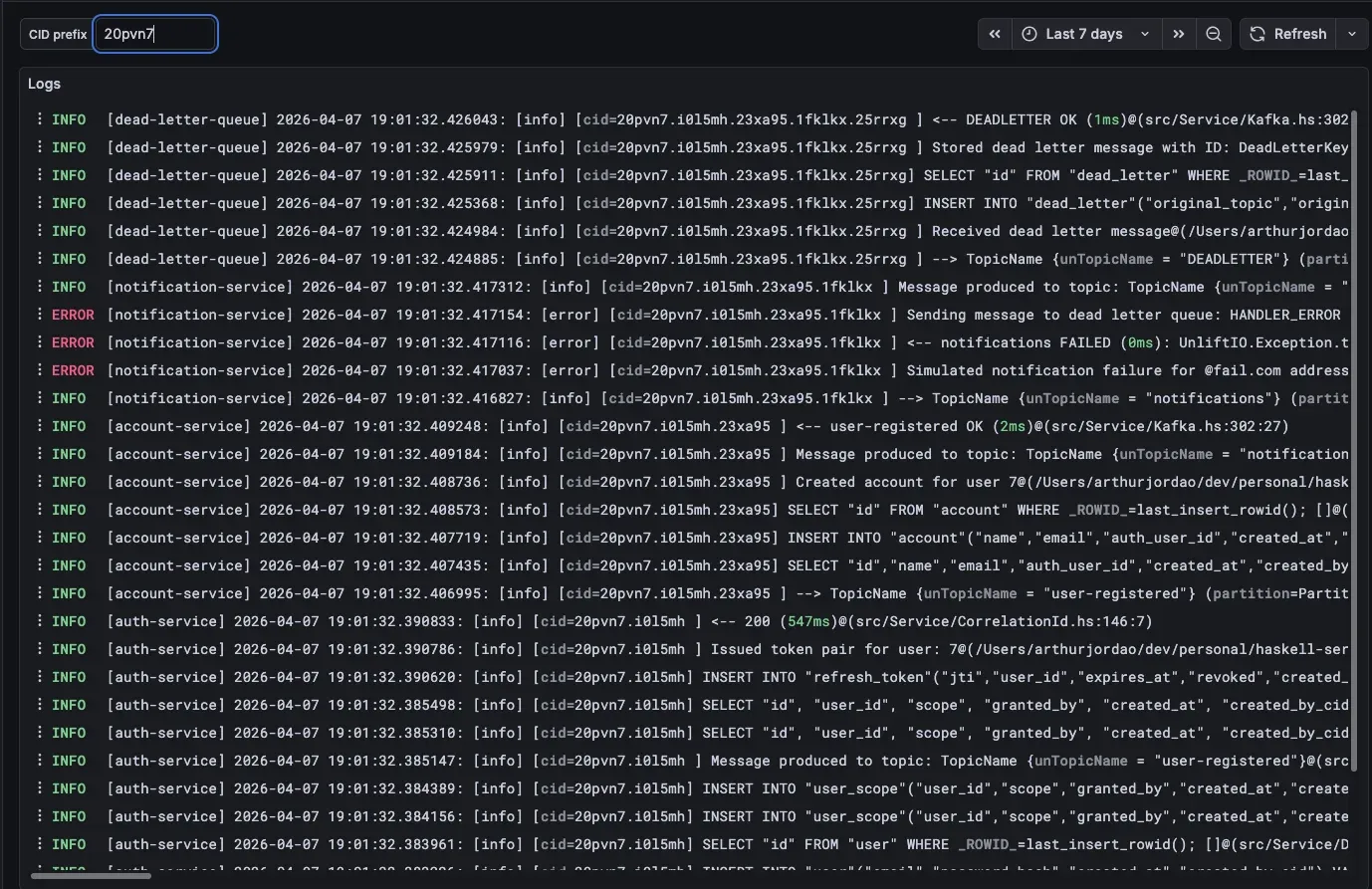
I set up Grafana/Loki/Prometheus to have service metrics and logs visualization, this makes it easy to debug any problems I could have in production.
One of the most useful dashboards I made was the CID investigator, which is a query that lets you trace every part of a request since the initial call.
Testing
The RIO pattern allows you to mock every component of the App, so if your function
depends on a HasDB env, you can build an APP that implements this and test your
function.
Every service follows the same pattern to create a test app, which mocks external component dependencies:
withTestApp :: (Int -> TestApp -> IO ()) -> IO ()withTestApp action = do...  let testApp =          TestApp            { testAppLogFunc = logFunc,              testAppLogContext = Map.empty,              testAppSettings = testSettings,              testAppCorrelationId = defaultCorrelationId,              testAppDb = pool,              testAppMockKafka = mockKafkaState,              testAppHttpClient = httpClient,              testAppMockHttp = mockHttpState,              testAppMetrics = metrics            }
    liftIO $ testWithApplication (pure $ testAppToWai testApp) $ \port' -> action port' testApp
With that we are able to make some tests like this http test:
it "respond with 200 on status" $ do withTestApp $ \port' _ -> do manager <- newManager defaultManagerSettings request <- parseRequest (baseUrl port' <> "/status") response <- httpLbs request manager responseStatus response `shouldBe` status200 responseBody response `shouldBe` "\"OK\""Since withTestApp populates the testApp, it can also produce Kafka messages, for example:
setupAccount :: TestApp -> Int64 -> Text -> IO ()setupAccount testApp uid email = runRIO testApp $ do let mockKafka = testAppMockKafka testApp event = UserRegisteredEvent {userId = uid, email = email} consumerCfg = KafkaPort.consumerConfig (Settings.kafka (testAppSettings testApp)) mockProduceMessage (MockProducer mockKafka) (TopicName "user-registered") Nothing event processAllMessages (MockConsumer mockKafka) consumerCfg...it "creates account automatically on user-registered Kafka event" $ do withTestApp $ \port' testApp -> do
-- Account is the first inserted row so its DB primary key is 1. -- The bearer token carries the auth user ID (42), which must match account.authUserId. manager <- newManager defaultManagerSettings req <- parseRequest (baseUrl port' <> "/accounts/1") resp <- httpLbs req {requestHeaders = [("Authorization", "Bearer token-user-42")]} manager statusCode (responseStatus resp) `shouldBe` 200Admin UI
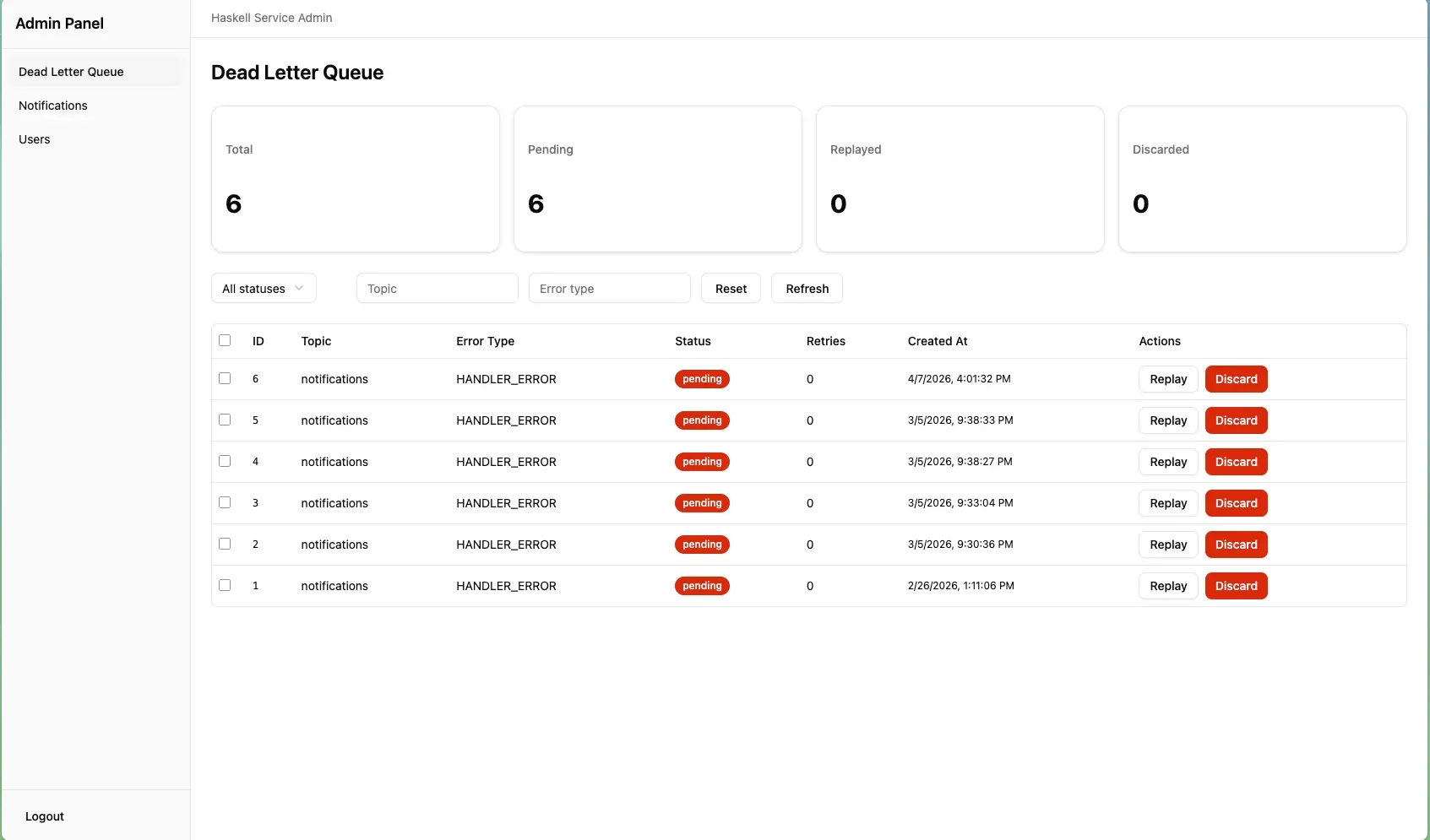
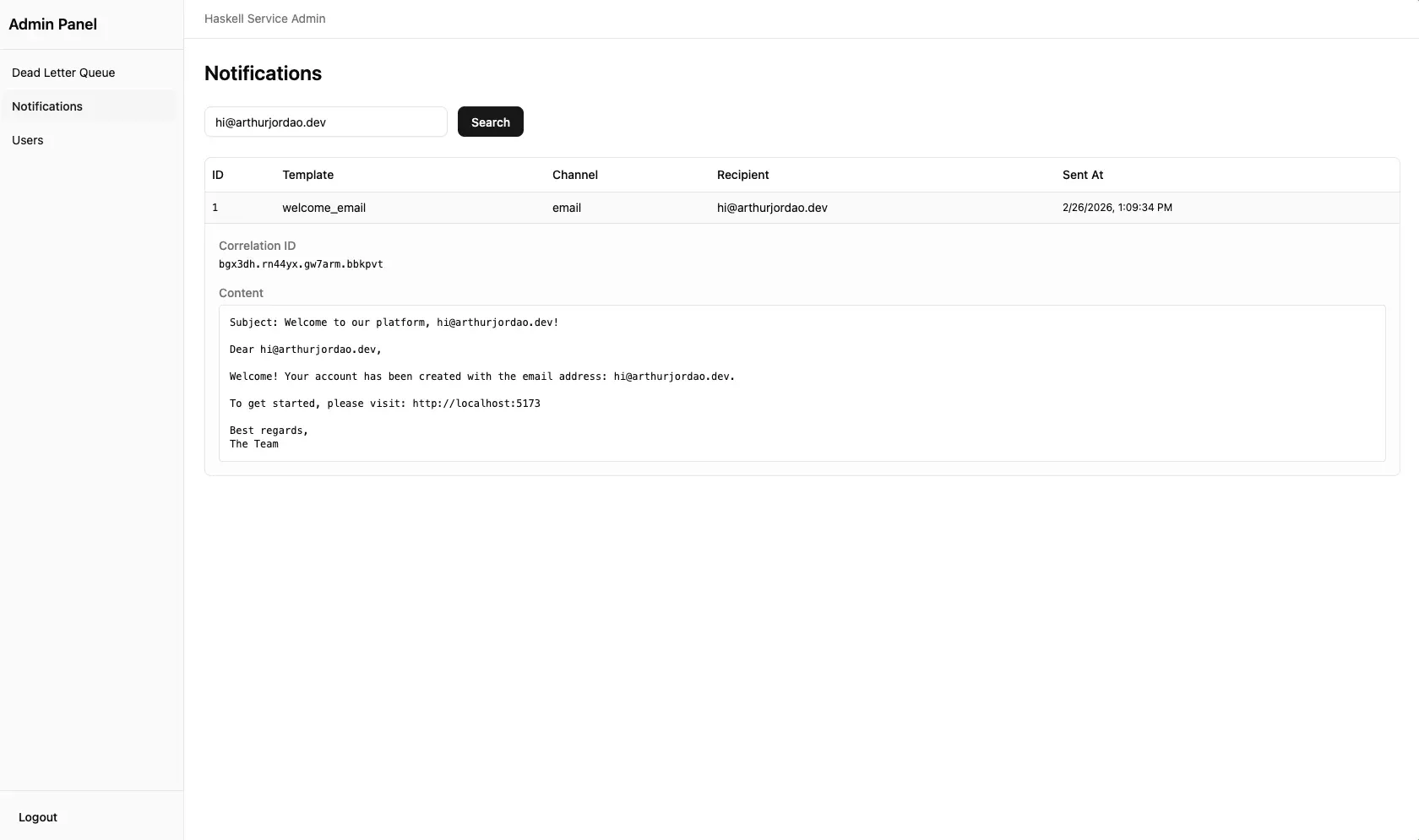
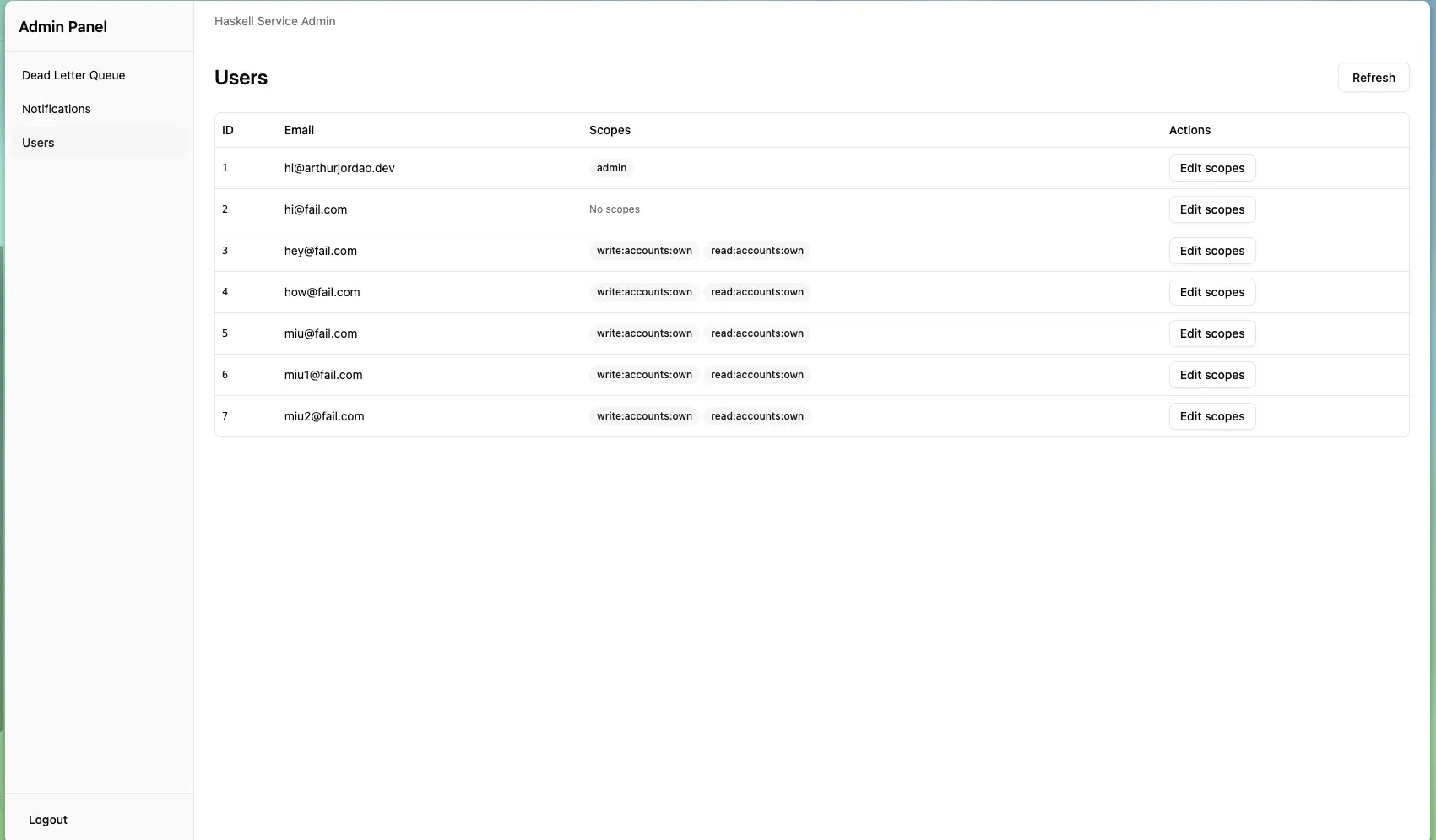
I also built a small react UI to have some admin capabilities.
It has:
- login, so only admins can access it.
- Deadletter queue management, so I can inspect and replay messages that failed during async processing.
- Notifications that got sent to other users.
How was the experience so far?
Building this tooling was very satisfying for myself. I find that Haskell has a unique superpower: it gives you confidence on the type system so you know that what you built is probably going to work.
Sadly, Haskell tooling is limited, there isn’t a ton of Haskell libraries as there are in more popular languages such as JavaScript. Type errors can be tricky to figure out. Have that in mind if you want to explore Haskell.
I am also sharing the code of this adventure as a reference, this is not a production ready code as it was mostly a project for fun, but there is a lot to learn from this.
Code: github.com/arthurjordao/haskell-service-template